Security teams rarely struggle because they lack another security product. They struggle because they have too many technologies solving disconnected pieces of the same problem.
That is the environment behind Cisco 300-745 SDSI. The exam reflects a change in security careers: engineers are increasingly judged by the quality of their security decisions, not only their ability to configure devices.
The Security Problem Changed Before the Tools Did
For years, enterprise security was built around recognizable boundaries.
Users were inside the office. Applications were inside the data center. Firewalls controlled the connection between trusted and untrusted networks. Security engineers focused on keeping those boundaries strong.
That model created a clear operational role.
An engineer configured access rules, maintained VPN connections, monitored alerts, investigated incidents, and ensured security platforms worked as expected.
The challenge is that modern environments rarely look like that anymore.
A company may have employees connecting from home, applications running across multiple cloud providers, contractors requiring temporary access, APIs connecting business systems, and compliance teams asking for detailed visibility into every important action.
The security question is no longer:
“Which security device should protect this network?”
The more difficult question is:
“How should security decisions be designed across an environment where users, applications, and data are constantly changing?”
That difference explains why the role of the security professional is moving toward architecture.
Cisco 300-745 SDSI (Securing Solutions with Cisco Security) represents this shift. It sits in the CCNP Security path, but the deeper value of the exam is not learning another collection of security technologies. It reflects a broader expectation: experienced security professionals should understand how individual controls become part of a complete security strategy.
The Difference Between Managing Security and Designing Security
The difference between a security engineer and a security architect is often misunderstood.
It is not about seniority alone.
A security engineer may have deeper hands-on experience with a specific platform. A security architect may spend less time configuring systems but more time deciding how different security capabilities should work together.
The difference appears when facing a complicated business requirement.
Consider a company introducing a new customer-facing application.
A traditional security approach might begin with technical questions:
- Which firewall rules are required?
- Which ports need to be opened?
- Which security appliance should inspect traffic?
Those questions are necessary, but they come later.
An architect begins earlier:
- What data does the application handle?
- Who should access it?
- How should identity be verified?
- What happens if the application scales globally?
- How will security teams monitor unusual behavior?
The technology choices follow the architecture decisions.
This is where many experienced engineers discover that architecture work requires a different type of thinking. Technical depth remains important, but it is combined with business understanding, risk evaluation, and long-term planning.
Cisco 300-745 SDSI aligns with this type of responsibility because enterprise security solutions are rarely evaluated as isolated features.
Why Cisco 300-745 SDSI Is Different From a Product-Focused Security Exam
A common assumption about advanced security certifications is that difficulty comes from the number of technologies covered.
That is only part of the challenge.
The harder question is usually:
“Can you decide why one security approach makes more sense than another?”
Security architecture involves trade-offs.
A highly restrictive security design may reduce risk but create operational problems. A flexible design may improve productivity but increase exposure. A solution that works for 500 employees may fail when an organization grows to 50,000 users.
Architects constantly balance these competing requirements.
Cisco 300-745 SDSI reflects this reality by focusing on securing solutions rather than simply operating individual products.
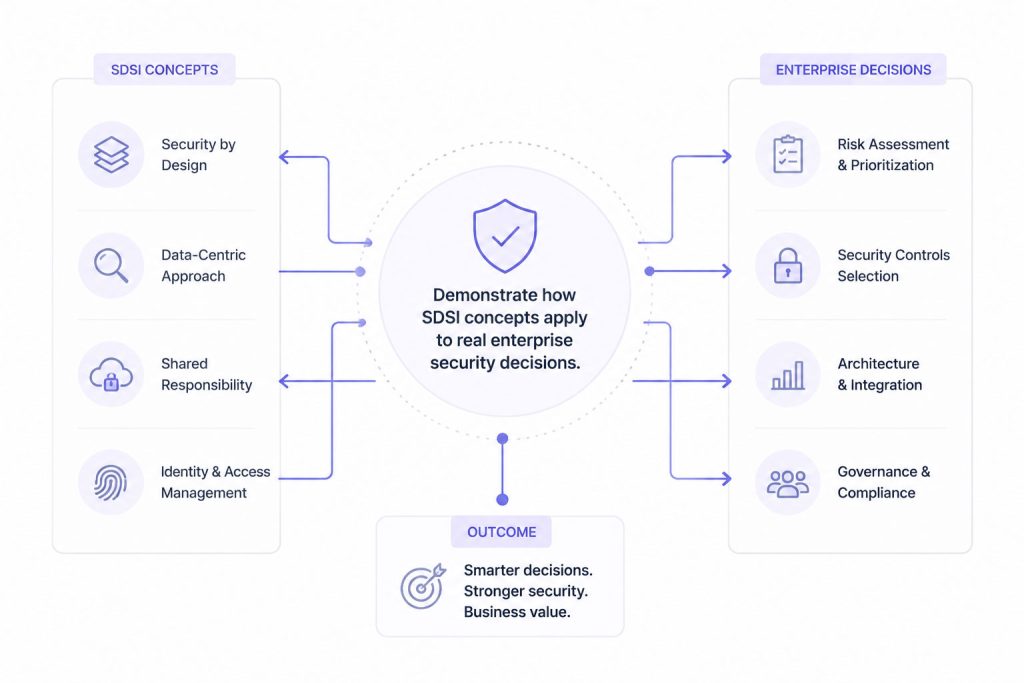
The knowledge areas connect concepts such as:
- security design principles
- secure infrastructure planning
- application protection considerations
- automation integration
- operational security requirements
The important point is the relationship between these areas.
A security architect does not think:
“Here is a firewall feature.”
The architect thinks:
“This security control supports this business requirement, reduces this risk, and integrates with these operational processes.”
That mindset separates architecture-level security decisions from configuration-level tasks.
The Architecture Questions Hidden Behind Everyday Security Decisions
Many security decisions appear technical on the surface but are actually architectural decisions.
Take identity security as an example.
A company with remote employees may need secure access to internal applications. A basic approach might focus on creating secure connections.
An architecture approach asks different questions.
Should access depend only on user credentials?
Should device security posture influence access?
Should users receive broad network access after authentication?
How should privileged accounts be controlled?
These questions connect with modern security approaches such as Zero Trust, where trust decisions are continuously evaluated instead of automatically granted.
Cisco has increasingly emphasized security architecture principles around identity, secure access, and integrated protection because organizations are dealing with environments where traditional network boundaries are less reliable.
The same applies to cloud environments.
A cloud security problem is rarely solved by adding one security product. Organizations must consider application design, workload communication, monitoring, automation, and operational responsibility.
A security architect looks at the complete system.
A Real Enterprise Scenario: The Problem Is Not the Firewall
Imagine a global company with:
- employees working remotely
- applications deployed in multiple cloud environments
- strict compliance requirements
- contractors requiring temporary access
- security teams responsible for monitoring threats
A product-focused discussion might begin with selecting security tools.
An architecture discussion begins with understanding the environment.
The security architect needs to determine:
| Question | Architecture Consideration |
|---|---|
| Who needs access? | Identity, authentication, authorization |
| What requires protection? | Data classification and business impact |
| Where are applications located? | Network and cloud design |
| How will threats be detected? | Monitoring and response strategy |
| How will security scale? | Automation and operational processes |
The final solution may involve multiple technologies, but the architecture decision comes first.
This is the type of reasoning that makes security professionals valuable at higher levels.
The challenge is no longer managing one security system.
The challenge is designing a security model that remains effective when the environment changes.
Why Experienced Engineers Sometimes Struggle With Architecture Questions
One of the interesting challenges with architecture-focused exams is that experienced professionals may find them uncomfortable.
The reason is not a lack of technical ability.
It is that architecture questions often remove the familiar answer.
A configuration problem usually has a clear objective.
A design problem often has several possible solutions.
The question becomes:
Which solution creates the best balance?
Security professionals moving toward architecture roles must become comfortable evaluating:
- business requirements
- security risks
- operational limitations
- future growth
- technical complexity
This is also why discussions among Cisco certification candidates often focus on understanding exam scope. Candidates preparing for SDSI frequently question how much product knowledge is required compared with design knowledge.
The answer depends on how someone approaches the exam.
A candidate who studies only individual technologies may understand what a solution does but struggle with why it belongs in a specific architecture.
A candidate who studies security decisions can connect technologies to business problems.
That second ability is closer to how architects work.
When researching preparation resources, candidates often compare different materials before choosing their study approach. Some explore resources such as Leads4Pass Cisco 300-745 SDSI resources alongside official Cisco materials and hands-on practice. The important factor is whether the resource improves understanding of security concepts rather than simply providing exam-focused information.
Where Cisco 300-745 SDSI Fits in the CCNP Security Path
Cisco security certifications represent different stages of professional development.
CCNA builds the networking foundation required to understand connectivity, protocols, and infrastructure concepts.
CCNP Security moves deeper into enterprise security technologies and operational responsibilities.
Cisco 300-745 SDSI adds another dimension: designing how security solutions work together.
This does not mean architecture replaces engineering.
Strong architects usually come from engineering backgrounds because practical experience reveals what designs work in real environments.
The difference is that architects must look beyond individual tasks.
They must understand consequences.
A technical decision made today can affect:
- future deployments
- security operations
- compliance efforts
- incident response
- business continuity
That broader view is what separates architecture thinking from administration.
Preparing for Cisco SDSI Means Changing the Question
A common preparation mistake is asking:
“What topics are on the exam?”
That question is useful, but it is not enough.
A better question is:
“What type of decisions does this exam expect me to make?”
For each security technology or concept, think about:
Why does this exist?
What problem does it solve?
What risks does it reduce?
What limitations should an architect consider?
How does it connect with other security controls?
This approach creates a stronger understanding of security architecture.
Hands-on practice remains valuable because architecture decisions must eventually become operational reality. But the goal is not simply knowing how to configure a solution.
The goal is understanding why the solution exists.
Conclusion: SDSI Represents a Larger Change in Security Careers
Cisco 300-745 SDSI reflects a change already happening across enterprise security teams.
The most valuable security professionals are not only the ones who can operate technologies. They are the ones who can decide how those technologies should fit together.
Security architecture is about creating systems that protect organizations while supporting real business needs.
That is why SDSI matters beyond the exam itself.
It represents the point where security engineering begins to evolve into security architecture — where the key skill is no longer only managing controls, but designing the strategy behind them.